Distal Biceps Tendon Repair: Technique, Strength, and Recovery
Elbow Tendon and Ligament Reconstructions
Elbow Tendon and Ligament Reconstructions
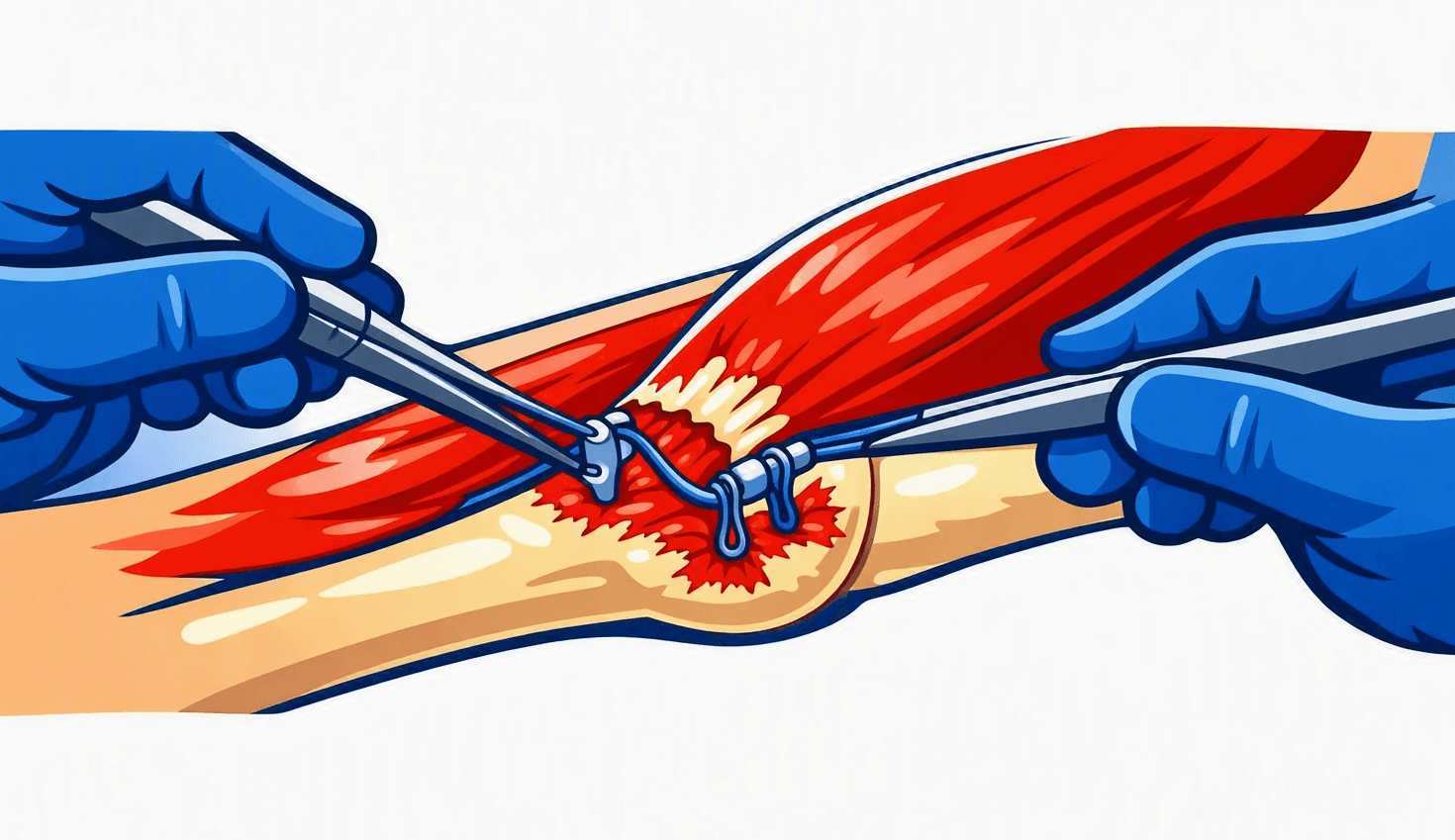
Distal Biceps Tendon Repair – What Every Patient Should Know About Surgery, Technique & Recovery
Posted by Eric J. Sanders, MD | Shoulder & Elbow Specialist
A distal biceps tendon rupture is a time-sensitive elbow injury, and the technique used to repair it — along with the experience of the surgeon performing it — has a real impact on your strength, recovery, and long-term result. This article covers the surgical technique I use, how the repair heals, what recovery actually looks like, and why choosing a high-volume specialist matters. If you are looking for a Dallas or Plano surgeon for a distal biceps rupture, I hope this answers your most important questions.
Do partial biceps tears also need surgery?
Sometimes, yes. A full-thickness rupture is not the only version of this injury that requires repair. Partial tears can also warrant surgery. When 50% or more of the tendon remains attached to bone, the elbow can be persistently painful, and non-surgical management often fails to resolve it. The most common finding in these patients is pain with elbow flexion and supination (the palm-up rotation motion).
How do I know if my biceps tendon is fully ruptured?
With a full-thickness biceps rupture, the diagnosis is often clear on examination. Beyond the associated deformity and the inability to "hook" the biceps tendon, weakness with palm-up motion — supination — is a telltale sign I look for during my exam. Sudden pain, a "pop," bruising, and a change in the shape of the upper arm are also common. If you suspect this injury, it is important to be evaluated quickly.
What surgical technique do you use for distal biceps repair?
I generally perform the procedure through an incision of one inch or less, using a minimally invasive technique. With advanced methods, I am able to repair the tendon primarily back to bone within the six-week window — meaning the native tendon is reattached directly to the radius without the need for a graft in most cases. Early surgery keeps this direct, primary repair possible, which is one of the reasons prompt evaluation matters so much.
Do you require a splint or brace after distal biceps surgery?
No. I do not require a splint or brace after surgery. This is intentional — avoiding immobilization allows for earlier range of motion and greater independence right after your procedure. My patients are allowed full range of motion immediately, which is a meaningful difference from more traditional protocols that restrict motion for weeks. Immediate motion, combined with a secure repair, supports a smoother early recovery and a faster return to daily activities.
How does the biceps tendon repair heal, and what does recovery look like?
The recovery timeline is structured around how the tendon heals back to bone:
Immediately after surgery: Patients are allowed full range of motion. No splint or brace is required.
First 6 weeks: Full range of motion is usually regained during this period.
6 to 12 weeks: Light loading is introduced — I allow up to 10 lbs during this window, in a non-repetitious manner, to protect the healing repair.
At 3 months: Patients can begin a strengthening program.
This progression protects the repair while it biologically integrates with the bone, then builds strength once healing is well established.
How strong is the repair? (Endobutton and FiberWire technique)
Repair strength is the reason I can allow immediate motion. The distal biceps repair I perform uses an Endobutton (cortical button) docking technique reinforced with a #2 FiberWire suture passed through the distal biceps tendon.
Biomechanical studies help put this strength in perspective. In cadaveric testing, the normal tension on the biceps tendon with the elbow held at 90° against gravity is only about 50 Newtons. The Endobutton technique has repeatedly tested as the strongest construct available: one landmark study found a statistically significant greater load to failure with EndoButton (440 N) than suture anchor (381 N), bone tunnel (310 N), or interference screw fixation, with no failures during cycling at physiologic loads. Put simply, the repair is far stronger than the everyday forces your biceps experiences early in healing. International Journal of Sports Physical Therapy + 2
How does that compare to the native, uninjured tendon? Modern cortical-button constructs have become impressively robust — a recent systematic review concluded that certain intramedullary and extramedullary cortical button techniques demonstrate biomechanical properties that can meet or exceed those of the native distal biceps tendon in cadaveric testing. The suture choice matters here too: FiberWire has been shown to have a higher ultimate load to failure and to resist more cycles before failing than older suture materials, which is why I use a #2 FiberWire in the repair.
The practical takeaway: this is a strong, secure construct. That security is exactly what allows immediate motion without a brace, while still respecting the biology of tendon-to-bone healing during those first several weeks.
Why is earlier surgery preferred?
Earlier surgery is preferred because it preserves the ability to repair the tendon directly to bone without a graft, and it is associated with a better, earlier recovery. The tendon and surrounding tissue begin to scar and retract after the injury, so the sooner it is addressed, the more straightforward the repair. Because timing matters, please call promptly — I often accommodate same-week surgery depending on when you are seen. Earlier evaluation and earlier surgery allow for a better recovery.
Does it matter whether a specialist or a generalist does the surgery?
Yes — this matters a great deal. For a procedure like a distal biceps repair, outcomes are generally better in the hands of a surgeon who performs these frequently, compared to a generalist who may only do a few per year. Higher-volume, fellowship-trained specialists tend to have more refined technique, more familiarity with the anatomy and its risks, and better results. My advice to patients is simple: seek out a specialist who does a high volume of these repairs, as I do. It is best to have this surgery done once, and done correctly the first time.
Schedule an appointment
If you have a suspected distal biceps rupture, don't wait. Earlier surgery allows for a better, faster recovery, and I often accommodate same-week surgeries depending on when you are seen — so please call promptly.
📅 Schedule an appointment with me through Texas Orthopaedic Associates: www.txorthopaedic.com
📍 Now seeing patients in Dallas and Plano
📞 Call (214) 750-1207
Answers to your questions
Get quick, clear information about our services, appointments, support, and more
How do I book an appointment?
Do you accept walk-in patients?
What should I bring for my first visit?
Where are Dr. Sanders clinics located?
Can I reschedule or cancel my appointment?
Do you accept health insurance?
Answers to your questions
Get quick, clear information about our services, appointments, support, and more
How do I book an appointment?
Do you accept walk-in patients?
What should I bring for my first visit?
Where are Dr. Sanders clinics located?
Can I reschedule or cancel my appointment?
Do you accept health insurance?
Answers to your questions
Get quick, clear information about our services, appointments, support, and more
How do I book an appointment?
Do you accept walk-in patients?
What should I bring for my first visit?
Where are Dr. Sanders clinics located?
Can I reschedule or cancel my appointment?
Do you accept health insurance?
Your shoulder wellness journey begins in one click
Book your appointment today and experience expert care designed around guiding you to a better recovery

Your shoulder wellness journey begins in one click
Book your appointment today and experience expert care designed around guiding you to a better recovery
Your shoulder wellness journey begins in one click
Book your appointment today and experience expert care designed around guiding you to a better recovery